
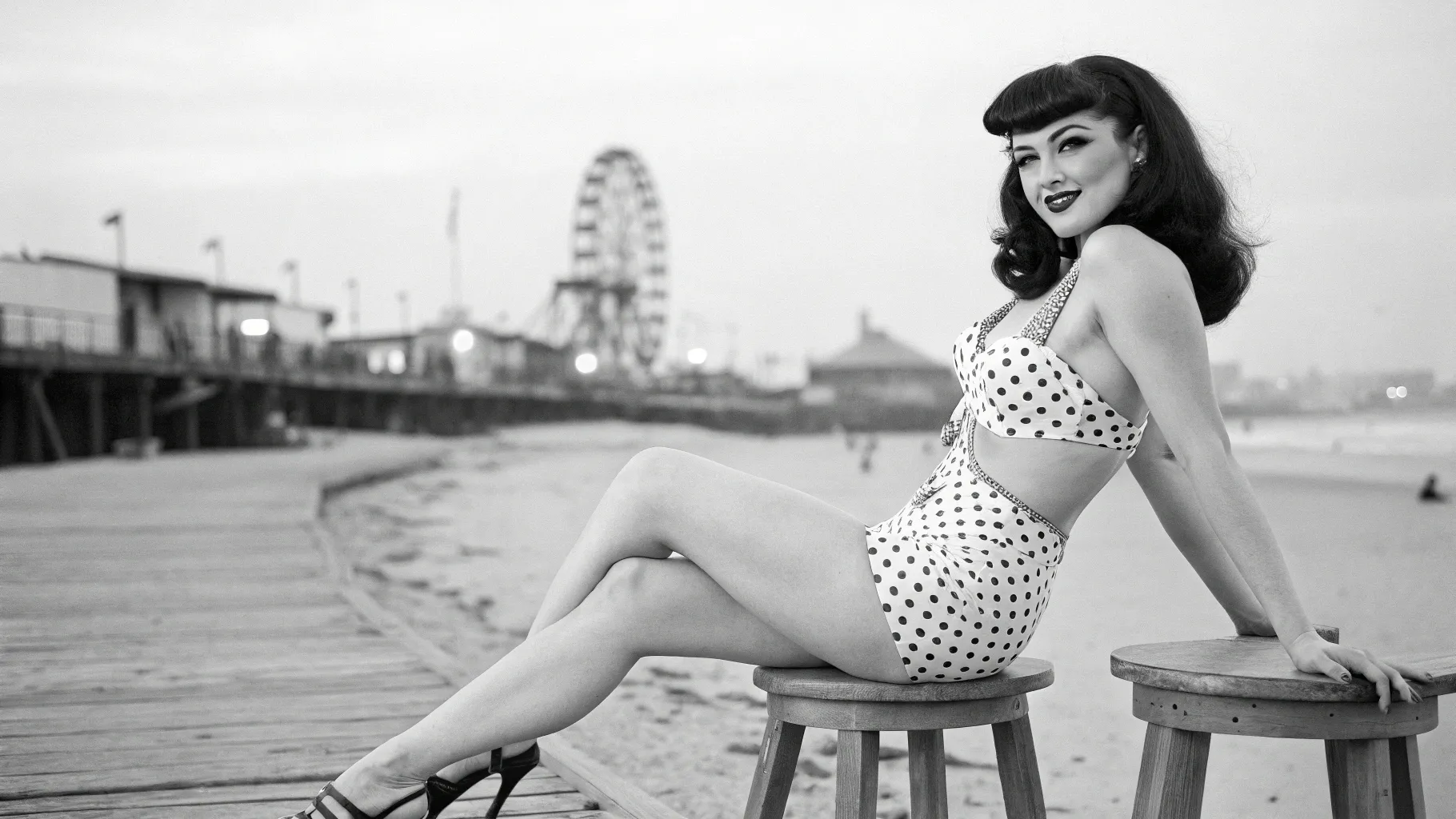
Bettie Page was more than a face. She became a cultural shorthand for midcentury sexuality, camp, and the power of a look that could be at once coy, mischievous, and defiant. Born in 1923 into a troubled household in Nashville, she rose from orphanage corridors and Depression-era hardship to become arguably the most photographed model of the 20th century. Her story is one of grit, choices made on her own terms, public vilification, quiet reinvention, and a legacy that continues to shape fashion, performance, and popular ideas about female agency.
Outline
- Early life and family struggle
- Education, marriage, and early career ambitions
- Move to California, the screen test, and a principled refusal
- New York, Coney Island, and the camera clubs that launched her career
- Modeling style, work ethic, and rise to fame
- Controversy: arrests, Senate hearings, and the end of an era
- Retreat, religion, mental health struggles, and disappearance from public life
- Rediscovery, late-life interviews, death, and lasting cultural influence
- FAQ
Early life: Growing up during the Great Depression
On April 22, 1923, Betty May Page entered the world in Nashville, Tennessee. She was the second of six children and the oldest daughter of Roy and Edna Page. Her father worked as an auto mechanic but struggled with alcoholism and could not hold a job. Her mother, with limited education and little choice, became the family’s primary breadwinner and caregiver. During the Great Depression, the Page family moved frequently as Roy struggled to keep employment, and the household was marked by instability and abuse.
When Betty was ten, her mother made the wrenching decision to divorce Roy. Edna took on full-time work to feed and clothe her children, but the pay was low and the family’s resources limited. With six kids to care for, Edna relied heavily on her oldest daughter. Betty quickly assumed responsibilities beyond her years—cooking, cleaning, and tending to younger siblings. Despite hardship, she maintained an effervescent spirit and a knack for performance. Backyard stages made of scavenged wood became her training ground and the neighborhood children her eager audience.
The family’s financial distress deepened to the point where Edna faced the impossible choice between starvation and surrendering children to orphanages. Betty and one of her younger sisters wound up in an all-girls home. It was a traumatic separation, but even there Betty used imagination as escape—encouraging her sister to play characters and pretend. That resilience would be a defining feature of her life.
Education, ambition, and the first marriage
Against the odds, Betty invested in education. In an era when many Americans left school early and relatively few women completed advanced study, she excelled academically. She joined the debate team, starred in school theatricals, and studied rigorously. Graduating second in her class earned her a full academic scholarship to Peabody Teachers College. These accomplishments weren’t just personal triumphs; they were acts of defiance against a childhood shaped by instability.
During high school she fell in love with Billy Neal, the archetypal cool teenager—motorcycle, leather jacket, swagger. They married while she was still a young woman. Billy enlisted in the Army and was stationed to San Francisco before going overseas. Betty became a teacher at her old high school, channeling her love of public speaking and performance into the classroom. But even as she taught, her radiant appearance made her a target of unwanted attention and harassment from male students who could not look past her physical presence.
When Billy was posted to California, Betty quit teaching and moved with him, taking a job as a secretary and holding on to the dream of Hollywood acting. A well-meaning office visitor suggested she try out for the movies, helping arrange a screen test at 20th Century Fox. That experience would teach her early how transactional and exploitative parts of the entertainment business could be.
The screen test that changed everything
Betty’s 20th Century Fox screen test was a rude awakening. She endured hours of makeup, hair, and costume manipulation until she hardly recognized herself. Producers told her she would have to change her look—go blonde, alter her makeup—to fit the studio mold. Worse, a man who had arranged the audition propositioned her, offering fame in exchange for sex. She refused. He threatened retribution; she walked away anyway.
That decision cost her an entry path into Hollywood, but it preserved something more important: her sense of self and moral boundaries. Around her, this pattern of predatory power—men demanding sexual favors in return for career advancement—was not exceptional. Yet Bettie refused to compromise that principle. The marriage proved incompatible with their divergent ambitions. Billy wanted a settled life in Tennessee; Betty wanted more. They divorced, and in 1947 she moved to New York City to try again.
Coney Island, Jerry Tibbs, and the camera club scene
New York did not yield immediate stardom. After a string of secretarial jobs and auditions with little progress, Betty was nearly 27 and running out of time—at least by the standards of the film industry personified at the time. A chance encounter on Coney Island with a man doing push-ups on the beach changed her trajectory. The man, a police officer named Jerry Tibbs who moonlighted as a photographer, offered her paid modeling work. She accepted.
When Tibbs asked her age she fibbed—claiming to be in her early 20s—which was typical for many women who feared ageism. The session went well, and Bettie’s photos began appearing in local girly magazines. In the postwar years pinup images had become deeply popular. They lifted spirits overseas and offered a kind of playful, glamorous ideal of femininity to the masses.
Tibbs invited her to join a camera club. In the 1950s camera clubs were studios where models posed while amateur and professional photographers paid for access. Some men were clearly there more to stare than to practice photography, but the clubs also served as breeding grounds for talented pictorial work. Bettie quickly distinguished herself.
Work ethic, craft, and the birth of a pinup icon
Bettie treated modeling as a business. Unlike many models of the era who might show up and simply be photographed, she worked out, watched her diet, and even sewed costumes that would read well on camera. She understood how to hold a pose, to use a smile that was at once inviting and coy, and to convey personality through body language. She needed little direction; she gave photographers everything they needed in a single frame. That blend of professionalism, discipline, and a warmly approachable persona made her irresistible to photographers and to the public.
Her look—jet-black bangs, wide eyes, a mischievous smile, and that perfect hourglass figure—became iconic. Men and women alike identified with her simultaneously as an object of desire and as an emblem of the girl next door. Her work grew in demand. As shoots grew more lucrative, Bettie accumulated wealth. The cameras that once recorded her as an amateur now made her a millionaire by contemporary measures in her industry.
When taste grew bolder: nudity, arrests, and legal battles
As popular culture’s boundaries shifted, photographers pushed for more risqué imagery. Bettie was pragmatic about the change. She famously said that being nude is not inherently disgraceful and that nudity should not be conflated with promiscuity. She continued to pose nude when she judged the work tasteful and tasteful was a subjective but guiding principle for her.
Not everyone agreed. A high-profile incident—an outdoor upstate New York nude shoot where models frolicked in fields—led to police arrests. Men were charged with disturbing the peace; women were initially charged with indecent exposure. Bettie refused to accept a lesser understanding of her conduct and demanded equal treatment, forcing authorities to amend the charges. Still, she spent time in jail over her work, but she did not allow that to end her involvement in pictorial art.
Her reach extended into magazines with mainstream circulation. Bettie was Miss January in 1955 in Playboy. Hugh Hefner later praised her influence and paid for photos from the photographer Bunny Yeager. Bettie’s appearance in glossy, widely distributed magazines made her a visible figure to audiences who had earlier only seen her in specialized publications.
The Movie Star News store, short films, and the Kefauver hearings
Bettie worked with the sibling entrepreneurs Paula and Irving Klaw, sellers of pinup photography and short film reels at their Movie Star News shop. They produced short films in which Bettie danced in lingerie; these were sold to paying customers. She also appeared in a handful of short cinematic works, such as segments in compilation films like Stripperama and Varieties. Always she hoped to parlay modeling into a broader show business career.
But the mid-1950s climate turned hostile. Senator Estes Kefauver led a subcommittee that investigated comic books, pornography, and materials considered corruptive to public morals. The hearings cast a wide net. Bettie was interrogated by the FBI and called to testify about whether Irving and Paula Klaw had been producing pornographic films. She defended the work she did, insisting that the reels were nonexplicit, with women never fully nude and never filmed with men.
Even when Irving Klaw was acquitted, the mere association with the hearings damaged Bettie. Newspapers printed her name; the moral panic of the era conflated coquettish imagery and social deviance. She was slut shamed in public. Men shouted at her in the streets. Her mailbox filled with threatening letters from a stalker who vowed to kill her. The FBI intervened, arranging a sting that used Bettie as bait to help unmask the letter-writer. The stalker turned out to be a 16-year-old boy, but the trauma of being publicly vilified had already taken its toll.
Retreat, religious conversion, and mental health struggles
By 1957 the Klaws shut down their operation and Bettie’s mainstream work dried up. She left modeling and the entertainment hopes that had once fueled her. Bettie moved to Florida and underwent a dramatic personal transformation: she became a born-again Christian. The church provided structure but also new conflicts. Religious leaders framed some of her past work as sinful. She attended Bible college with hopes of serving as a missionary in the 1960s, only to be rejected because she was a divorcee. Attempts to return to academia—graduate courses toward a master’s degree—were thwarted by the lingering reputation that had followed her for decades. Ultimately she dropped out.
Her mental health deteriorated. By the 1970s she had a nervous breakdown and was diagnosed with schizophrenia. Hospitalization and psychiatric treatment followed. Part of her recovery involved a kind of deprogramming: religious communities had convinced her for years that she was a sinner who needed to atone for her career. Therapeutic work helped disentangle those beliefs from the woman she actually was and what she had accomplished.
Rediscovery, later life, and the verdict of history
For decades Bettie disappeared from mainstream conversation. That absence added to the fascination. The photographic body of work she left behind had been widely circulated in multiple forms, and new generations of collectors, designers, and performers began to find and celebrate the images. In 1998 Playboy tracked her down for an interview. When asked whether she had felt ashamed of her work, Bettie answered plainly: "I never thought it was shameful. I felt normal. It was just that it was much better than pounding a typewriter eight hours a day."
Those late decades brought a flood of fan letters and appreciation. People told her how her work had been formative, liberating, or simply beautiful. She was finally able to receive the recognition and affection that had often been denied during the storm of midcentury morality.
Bettie Page died of a heart attack in 2008 at age 85. At the time of her death her estate was substantial—reports say a net worth of twenty million dollars. Her name, face, and hairstyle continued to be reproduced on clothing, posters, and merchandise. In 2017, for example, licensed Bettie Page merchandise reportedly brought in millions of dollars. Her estate remains commercially active, and the images that once scandalized are now part of mainstream visual culture.
Why Bettie Page matters: influence and legacy
Today the kind of near-nudity Bettie specialized in is common in advertising, fashion editorials, and social media. Brands such as Victoria’s Secret and Calvin Klein have normalized a kind of commercialized sexual display that would have been labeled deviant in Bettie’s era. Instagram and personal image-sharing platforms have made self-curated pinup aesthetics accessible to many.
Her look directly inspired fictional and real figures. Jenny Blake in the comic book The Rocketeer draws on Bettie’s iconography. Performers like Dita Von Teese channel her burlesque and vintage glam. Pop stars from Madonna to Katy Perry have nodded to Bettie’s bangs, eyes, and playful poses in videos and performances. Yet beyond the stylistic echoes, modern feminists and many women admire Bettie for what she represented: a woman who was strong, smart, independent, and who refused to be defined by shame.
Bettie’s refusal to sleep with men to obtain her success—while still doing provocative work that she considered tasteful—aligns with a complicated, contemporary conversation about agency. She navigated a world where power was overwhelmingly male and where moral panics could crush careers. She made choices that worked for her, not always the choices the culture wanted to make for her.
Key takeaways: the arc of a complicated American icon
- From poverty and abuse to academic success, Bettie’s earliest life demonstrated resilience.
- She was principled in the face of exploitative offers, prioritizing personal boundaries over career advancement.
- Her modeling was professional, deliberate, and influential; she helped set new standards for how women prepared for and controlled their image.
- Public morality and political crusades derailed her career and harmed her mental health.
- Her later rediscovery reframed her as an influential cultural figure, admired for aesthetic and feminist reasons.
Selected quotes
"Being in the nude isn't a disgrace unless you're being promiscuous about it."
"I never thought it was shameful. I felt normal. It was just that it was much better than pounding a typewriter eight hours a day."
Further reading and suggested sources
To go deeper, look for biographies, documentary footage, and archival issues of midcentury magazines. Scholarly accounts of Senate hearings on obscenity, histories of pinup culture, and retrospective interviews from publications such as Playboy help illuminate both the era and Bettie’s place within it.
Who was Bettie Page?
Bettie Page was a mid-20th-century American model who rose to fame in the 1950s for her pinup photography. Born in 1923 in Nashville, she became an iconic figure in popular culture and is often called the Queen of Pinup. Her look and style influenced fashion, music videos, and modern performers.
Why was Bettie Page controversial in her time?
Bettie’s work often pushed the boundaries of what the era considered acceptable. Nude and fetish-style imagery led to arrests, public shaming, and investigations during a period of conservative cultural policing, including Senate subcommittees concerned with obscenity. These controversies damaged her career and reputation.
Did Bettie Page work with Playboy?
Yes. Bettie Page appeared as Miss January in Playboy in 1955. Hugh Hefner purchased some of her photos and later praised her influence on fashion and sexual taste in popular culture.
Why did Bettie Page stop modeling?
Multiple factors contributed. Political pressure and moral panic after Senate investigations into supposed obscenity hurt her employers and market. Her main collaborators shut down their operations in the late 1950s, and Bettie chose to retire from modeling, later turning toward religion and attempting to live a private life.
What happened to Bettie Page later in life?
After leaving modeling she became a born-again Christian, attended Bible college, and attempted missionary work and graduate study, but reputation issues persisted. She experienced mental health challenges, including a diagnosis of schizophrenia and hospitalizations. In the 1990s she was rediscovered and received renewed public appreciation. She died in 2008 at age 85.
How does Bettie Page influence culture today?
Bettie’s imagery and style have influenced film, comics, fashion, and performance. Performers like Dita Von Teese and pop stars such as Madonna and Katy Perry have drawn on Bettie’s look. Her legacy also feeds into conversations about female agency, sexual expression, and how aesthetic choices intersect with personal autonomy.
Final thoughts
Bettie Page’s life resists easy categorization. She was a performer who transformed adversity into a career, a woman who guarded her dignity even as she photographed herself nude for a paying market, and a public figure who was both celebrated and condemned. Her story reflects broader American tensions across the 20th century: between scarcity and prosperity, between prudery and liberation, between the power of visual culture and the vulnerability of those who make it.
Her images—still reproduced on T-shirts, posters, and in tattoo studios—remain a study in contrasts: playful yet pointed, marketable yet misunderstood, simple in appearance yet complicated in meaning. She became a symbol for later generations, not merely because she posed for pictures, but because she did so with agency and a signature look that made people look back and take notice.



 Posts
Posts


0 Comments